macOS
Double-click launcher
Clone or download the source, then open START-NIMANTO.command.
Unreleased local build · v0.10.0-dev.0
Approve the search, inspect each explanation, and control every handoff in one local-first workbench for H-1B professionals.
01 — Thesis
A job search usually becomes a pile of resumes, saved roles, sponsorship rumours and half-finished forms. Nimanto gives that work one inspectable path: build a confirmed career record once, see exactly why a role fits, compare what you actually stored, and approve every handoff yourself.
It is a candidate tool. It does not screen you for employers, guess your odds, or promise that a company sponsors transfers today.
02 — Workbench
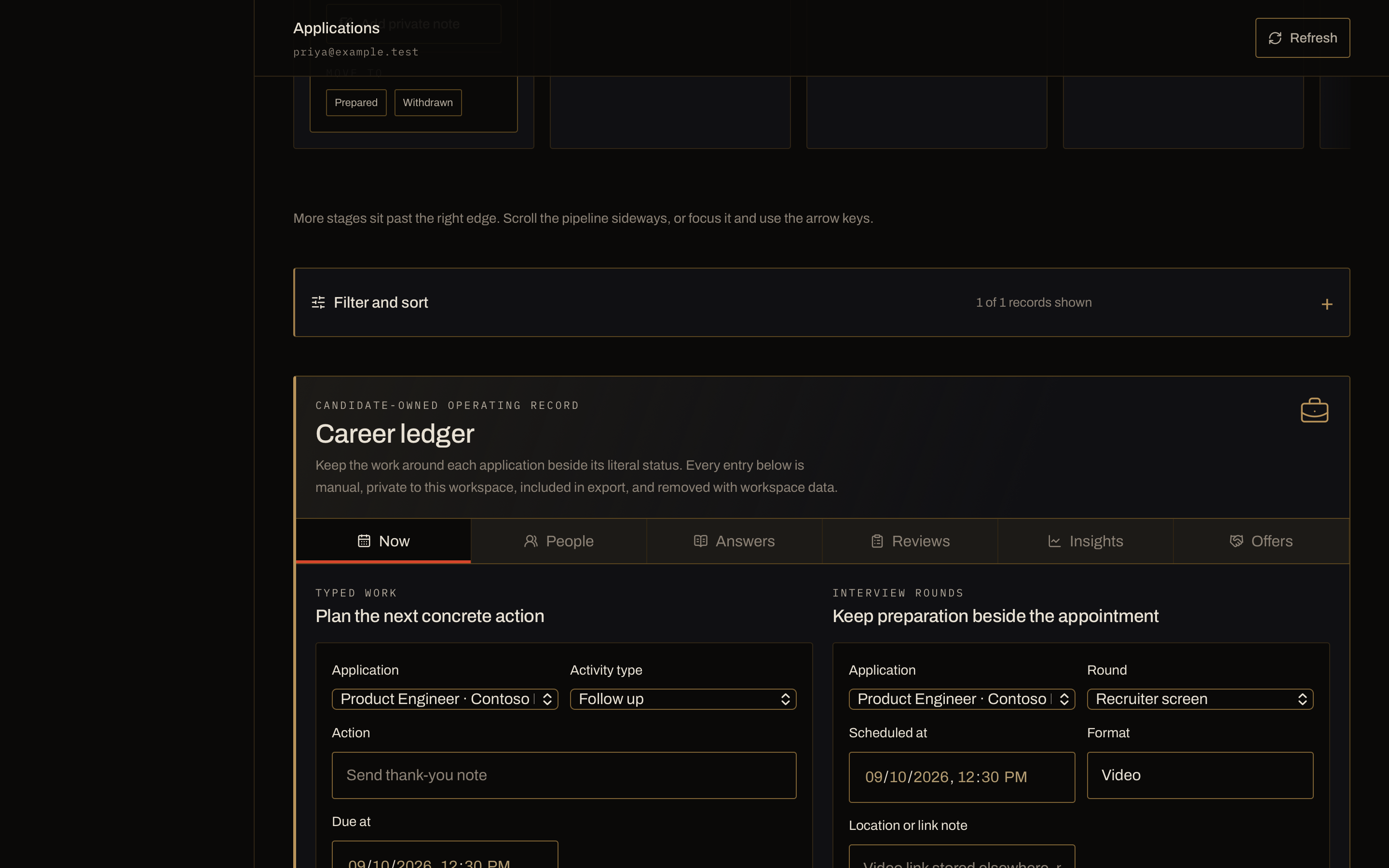
Applications opens on the record you can work. Its candidate-owned Career Ledger keeps activities, interview rounds, people, reusable answers, saved reviews, descriptive timing observations, and offer terms beside the pipeline. Unsaved fields stay in the signed-in tab; an identity change clears the old workspace first.
The screen is synthetic current-runtime evidence. Outcomes are records entered by the candidate—not inferred employer state.
03 — Method
Source, claim, requirement and output stay connected end to end. Nothing becomes verified merely because a parser or a model said so.
Review the exact bounded claim projection from TXT, Markdown, JSON, DOCX, a text-layer PDF, or approved LinkedIn archive fields. Evidence fields stay with the signed-in tab while you move between sections; every new claim still waits for you.
Approve one discovery profile, then search manual, allowlisted URL, Greenhouse, Lever, and Ashby roles without erasing source identity. Every explanation replays the exact matched, excluded, and unresolved inputs; two current roles can still share one neutral comparison.
Set one literal follow-up date or use the 336-hour activity fallback, then keep typed work, interview rounds, people, reusable answers, saved reviews, sample-sized timing observations, and candidate-entered offer terms in one Career Ledger. The workbench shows stored values without inventing a cause or employer outcome—and a date never contacts anyone.
Inspect canonical claims, authorization wording, format checks and assurance bound to the exact frozen artifact and manifest before reviewable JSON, text, modern and ATS-safe DOCX/PDF leave the workbench.
Pass assurance, approve the current packet, approve the exact action, then turn on a runtime switch that resets itself off. A newer packet retires older handoffs before they can run, and hash-checked local receipts never claim an employer received it.
04 — Worked example
A requirement is only supported when a confirmed claim supports it, and the link between the two is drawn rather than implied.
Role requirement
TypeScript service deliveryConfirmed evidence
Led a typed service migrationProject record · source line 3
Why it matters
Direct skills overlap, linked to one confirmed claimVisible blocker
Posting states no sponsorship of any kind05 — Boundary
Nimanto never ranks people for employers and never estimates anyone’s hiring probability.
An imported claim stays pending until you confirm it. A parser saying so is not evidence.
Nothing leaves this machine without assurance, approval of the current packet, an exact action approval, and a live switch.
Application timelines and retained comparisons contain only stored records. A gap or difference is not a rejection, a cause, or a prediction.
Current posting words, employer policy, and historical government records stay separate. Historical evidence never proves that a role sponsors today.
06 — Run it
Node 24–26 and pnpm 11 on macOS, Linux or Windows. Your evidence stays on the machine running Nimanto. There is no hosted backend to opt out of.
macOS
Clone or download the source, then open START-NIMANTO.command.
macOS · Linux · Windows
Install the exact locked graph and start the local API, worker, and website.
Node 24–26 · pnpm 11 · loopback servicesSelf-hosted QA
Build the source image with demo login off and data in a named private volume.
Ports stay bound to 127.0.0.1 · not internet-certifiedTerminal start
git clone https://github.com/udhawan97/Nimanto.gitcd Nimanto && git checkout v0.9.0corepack enable && pnpm install --frozen-lockfile && pnpm devOpen the private workspace URL printed by the API. Its launch key stays in the URL fragment only long enough for the workbench to capture and remove it.
07 — Help
The operations guide names the launch-key, port, backup, provider, and recovery boundaries. Security reports have a separate private route.