Codemble reads a project on your machine and turns its real structure into a galaxy you can explore or a diagram you can follow. Study real source, trace parser-proven routes as far as the evidence goes, see what a change reaches, and light only what you prove you understand.
The screen, command, and downloads all describe v0.24.0, mirrored on GitHub with checksums.
Codemble v0.24.0 · luminous Explore galaxy245 systems · nine languages · local only
v0.24.0 keeps evidence coherent under change. Study verifies one source snapshot, checks ask only parser-supported questions, and overlapping saves or provider timeouts cannot silently rewrite truth.
These are not mockups. Each frame is a fresh capture of the tagged Codemble release, with the same Home and the same parser-owned graph.
Release capturesame project · same Home
Release capture · Explore
01 · Explore
Begin with a sky that is already readable.
All 245 systems are visible and colourful on the first frame inside a luminous deterministic sky. Free exploration keeps the whole project alive; a guided First Flight may quiet distant context while it teaches one parser-owned route.
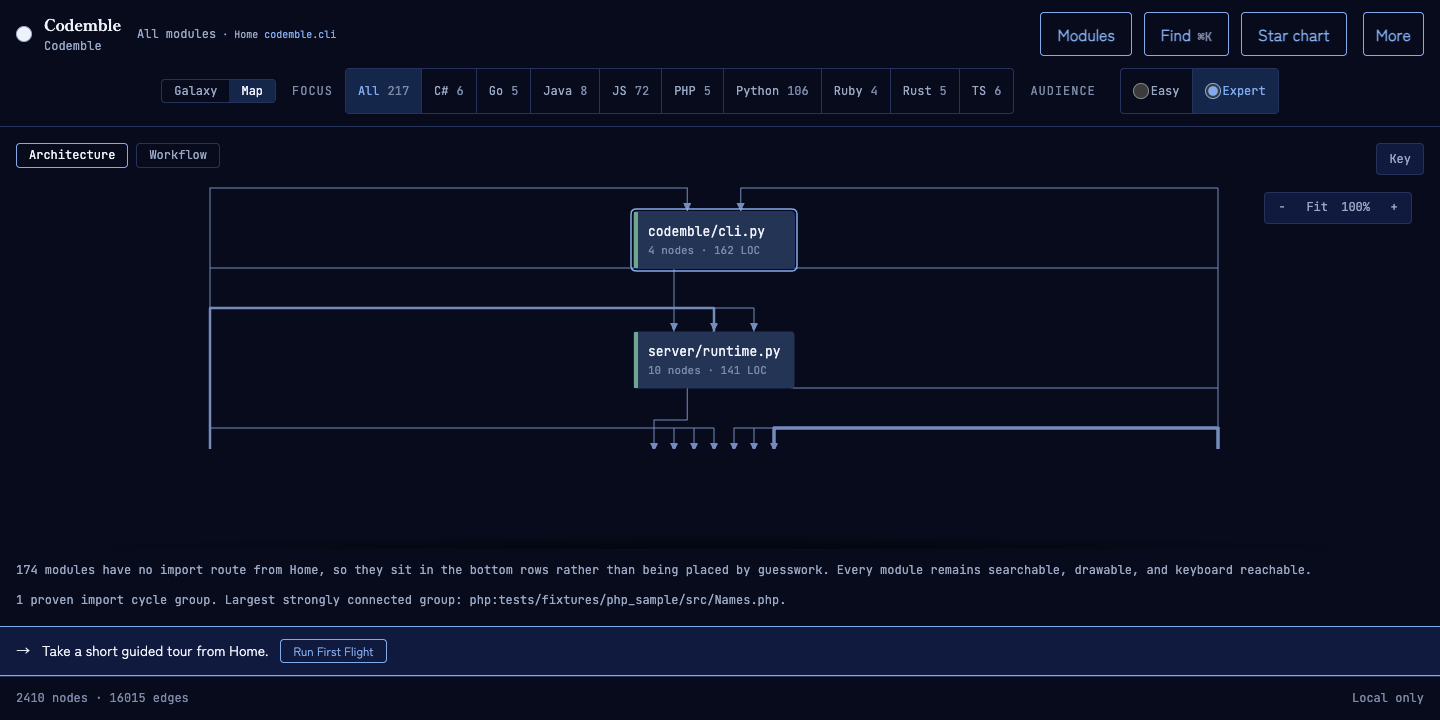
Release capture · Map
02 · Map
Flatten the same evidence into a reading path.
Architecture lays modules out by proven imports from Home. Workflow follows certain calls from the entrypoint. Modules with no proven route remain in complete bottom rows rather than being guessed into the graph.
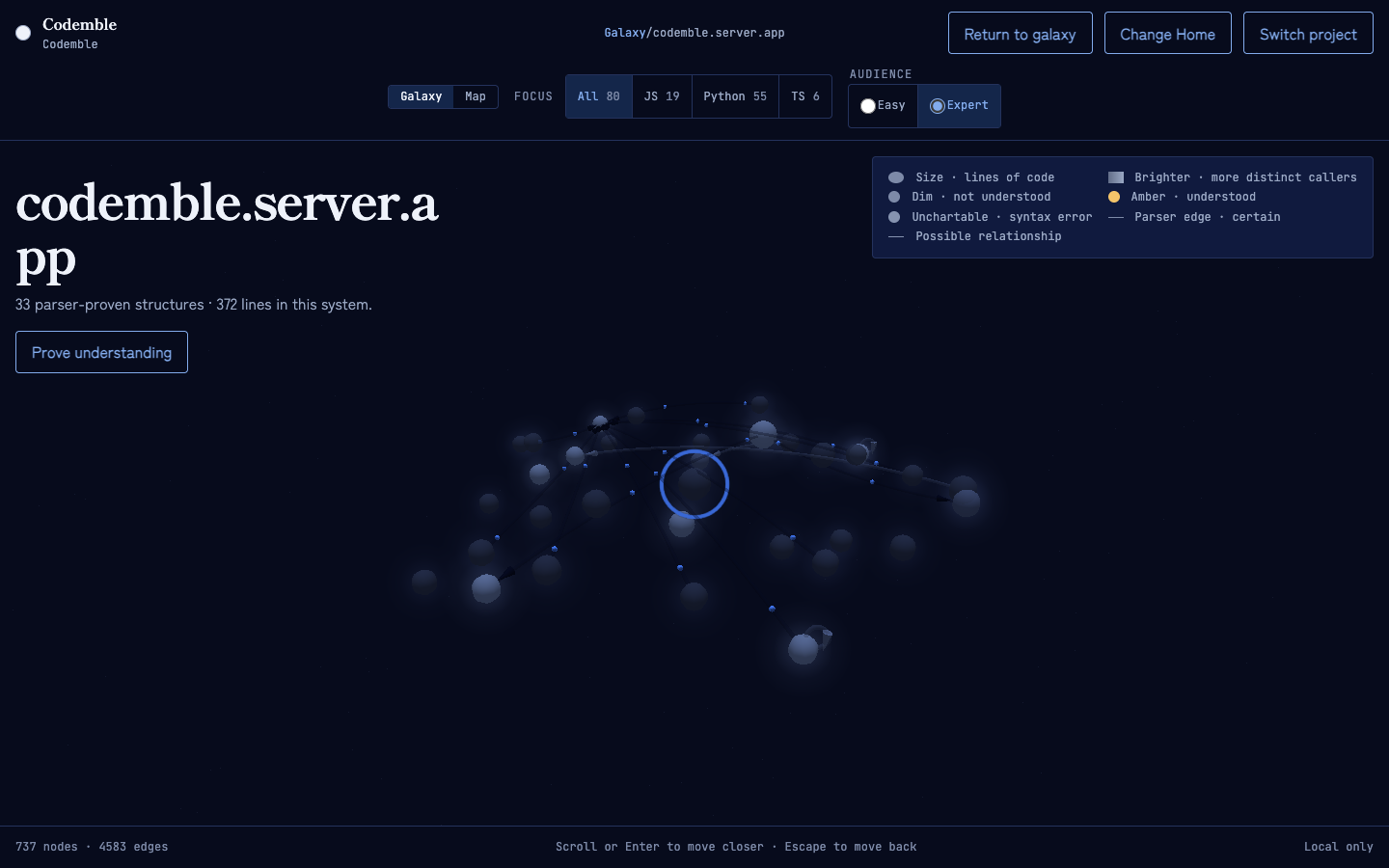
Release capture · Land
03 · Land
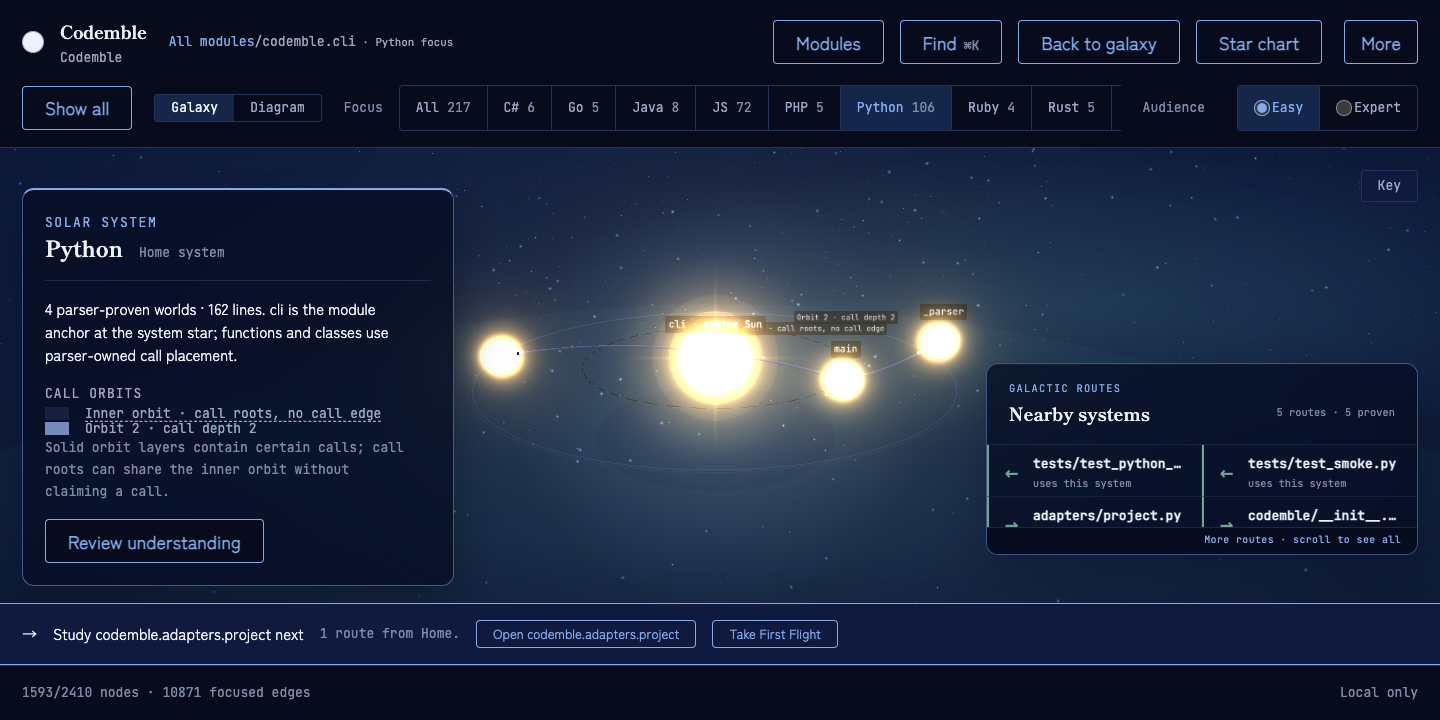
Enter a solar system with a real Sun.
The module anchor becomes the system's Sun. Named functions and classes become language-styled worlds in parser-owned call placement, while the nearby-systems console continues along certain and possible imports without merging them. Land on any world for Easy or Expert evidence.
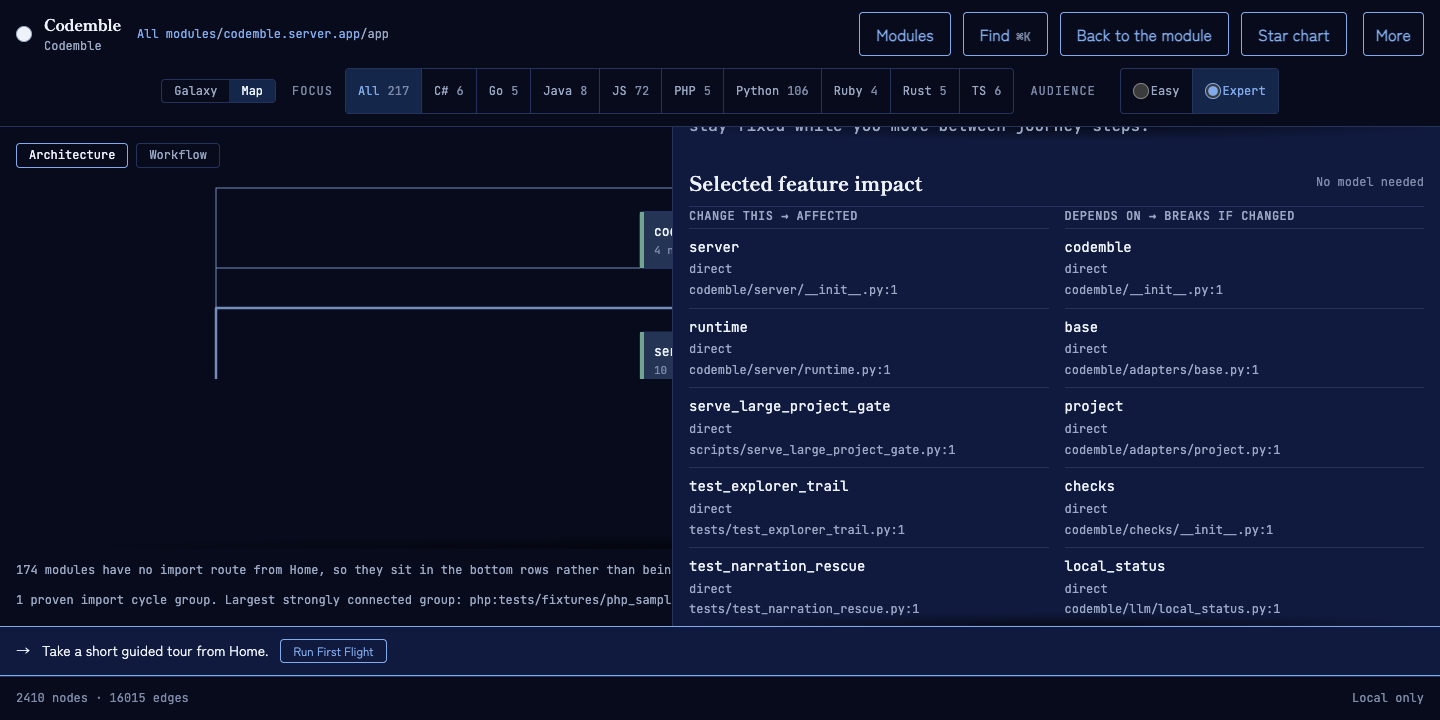
Release capture · Inspect
04 · Inspect
Follow the feature route before a model speaks.
Study follows parser-owned evidence only as far as it reaches from Home toward the selected feature. A visible proof break stops the journey before any separate possible frontier. Easy guides a cited step; Expert keeps that step and adds its parser rule, while selected-feature impact, connections, and test candidates stay clearly scoped.
Release capture · Prove
05 · Prove
Earn the one colour that means understanding.
Short checks come from the graph, never the narrator. Pass Home and its four parser-proven structures glow amber; the next useful route advances while charted systems remain a separate record of where you have been.
Choose the route that fits today.
Run without installing, download the exact wheel, or keep an editable source checkout. The command and artifacts below lead to stable v0.24.0.
Recommended
Run Codemble v0.24.0
Best for a first real project. It is the latest GitHub release and PyPI package, with the exact wheel, source archive, and SHA256SUMS ledger mirrored on GitHub.
Point it at a folder. Codemble reads supported source without running your app, package scripts, compilers, or tests.
Choose your launch
Start in a luminous, fully visible galaxy or take a bounded First Flight from Home. Explore keeps every system colourful; Learning can quiet distant context while guiding one honest route.
Enter a living solar system
The module anchor is its Sun. Named functions and classes become language-styled worlds in call orbits that keep direct calls and call roots distinct, while a nearby-systems console follows parser-owned inbound and outbound imports with certainty intact.
Know what a change touches
Impact traces what the parser map found depending on a structure and what it depends on, with real file locations and certainty labels—no model required and no claim beyond the map.
Prove what you understand
Graph-derived checks are the only way to light a system amber. Visiting and understanding remain two different claims.
Keep the project local
Parsing, maps, feature journeys, source, Impact, checks, and progress stay on your machine. Optional narration goes only to the provider you configure.
Read nine languages together
Python, JavaScript, TypeScript, Go, Java, Rust, C#, Ruby, and PHP share one honest graph contract, including mixed projects.
One project can mix:PythonJavaScriptTypeScriptGoJavaRustC#RubyPHP
The map admits where certainty ends.
Codemble is for readers who may not yet spot a confident mistake. Accuracy therefore outranks visual drama, feature count, and model fluency.
01
Nodes, routes, concepts, Home candidates, and application roles come from parsers—not generated prose.
02
A feature journey stops where proof stops, before showing a visibly possible frontier.
03
Impact and checks are graph-derived and work without any API key.
04
Study refuses changed source before old graph facts or narration can be mixed with new bytes.
05
Narration may name only supplied identifiers and cite real source lines.
06
Changing a file re-dims only the proof attached to that file.
07
Unsupported or broken source is counted and named instead of silently omitted.
Before you point it at a repository.
Does Codemble run my code?
No. It reads supported source files and parses their structure. It does not run the project, package scripts, compilers, or tests.
Do I need an Anthropic or OpenAI key?
No. The galaxy, maps, feature journeys, source, structural summary, Impact, Lens, checks, and saved progress all work without a model. If you configure a narrator, opening Study automatically requests grounded prose with bounded context.
Are these screenshots from the downloadable app?
Yes. They are fresh captures of v0.24.0, the same release provided by the pinned command and verified downloads.
What happens when Codemble cannot prove a relationship?
It ends the proven route at a visible break, then shows only the possible frontier that can still lead toward your selected feature. Broken or unsupported source stays counted instead of vanishing from the picture.

 Download Codemble
 Run in one command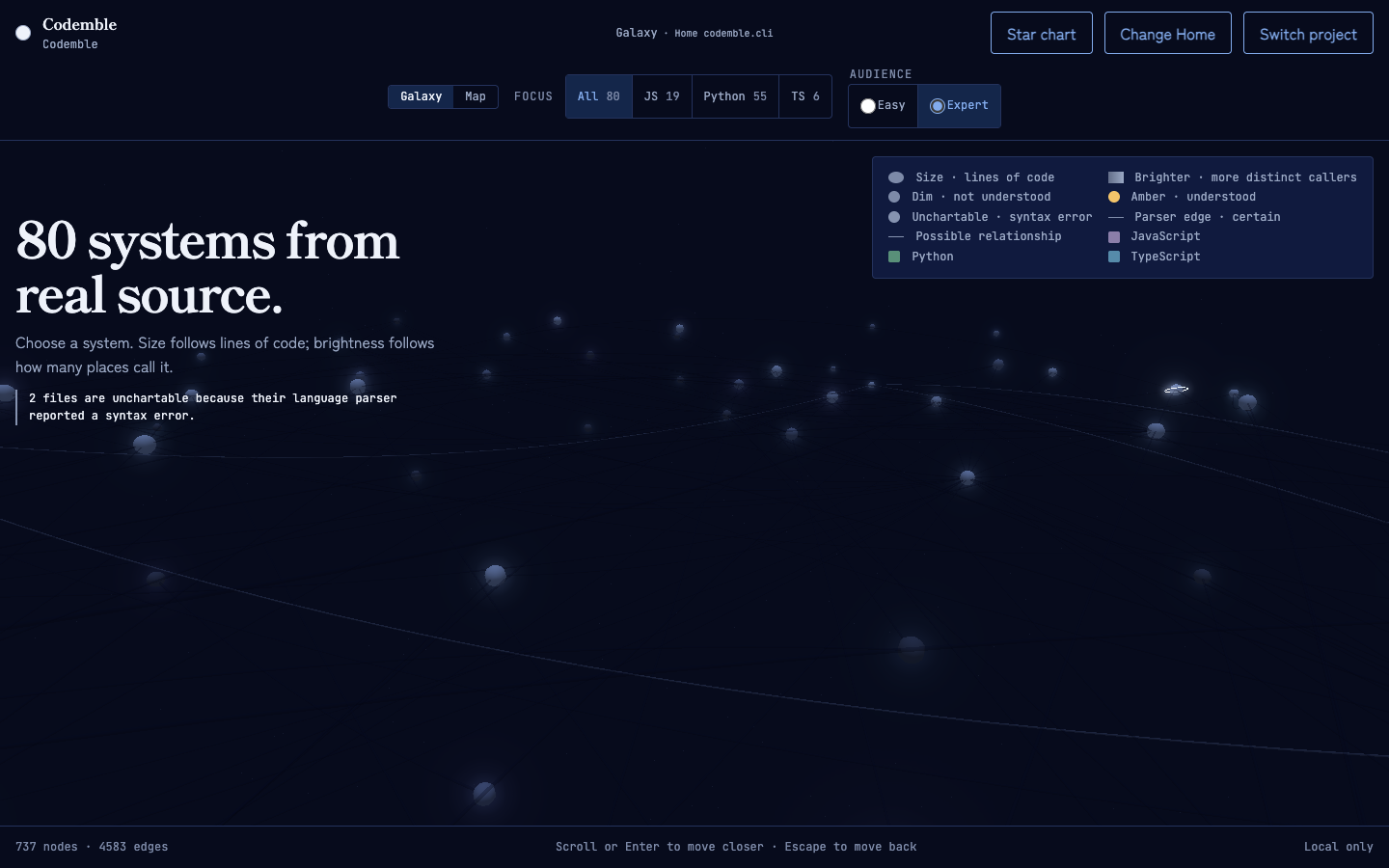

 Source archive
 SHA256 digests
 Release notes
 Choose your launch
 Enter a living solar system
 Know what a change touches
 Prove what you understand
 Read nine languages together