

Architecture
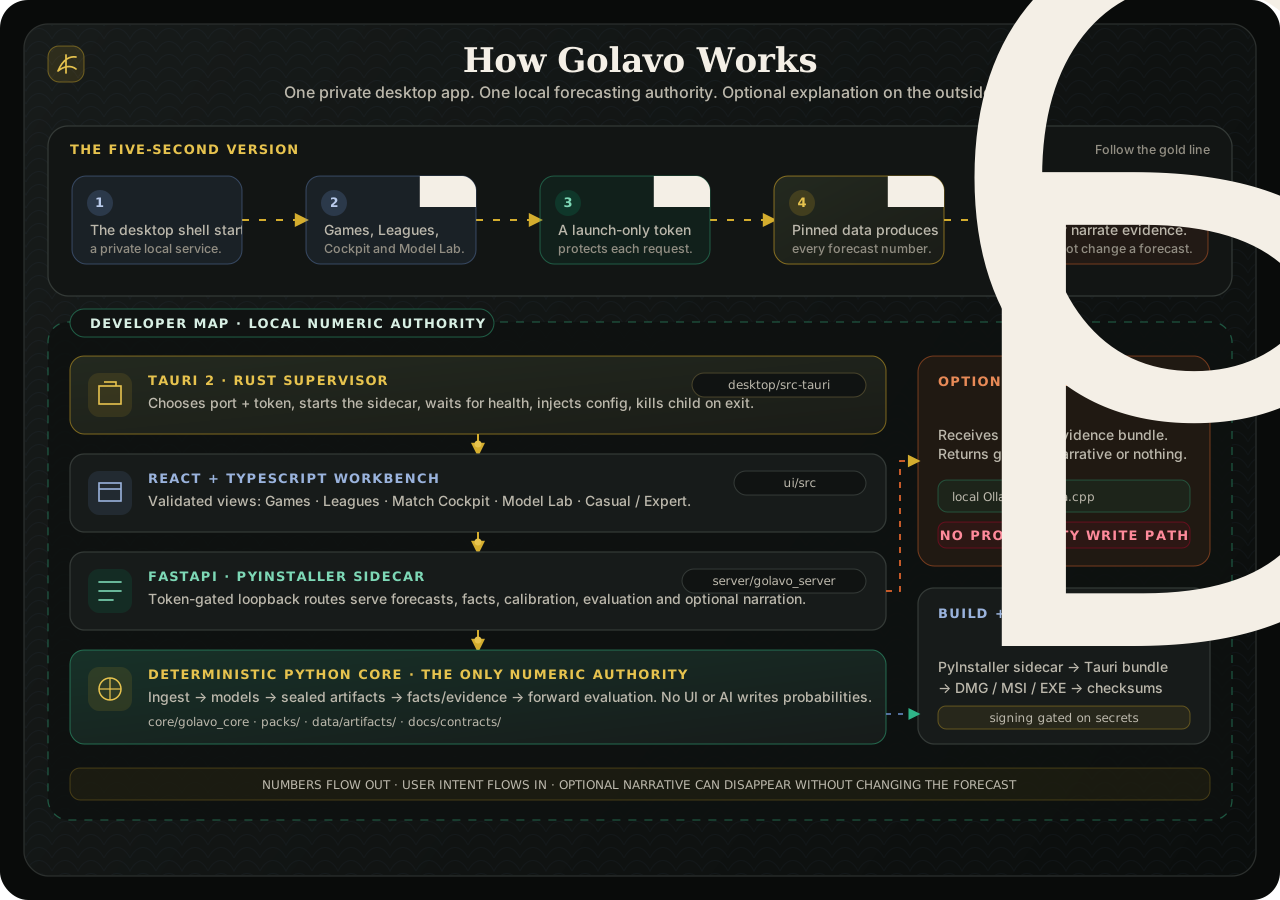
Golavo is a deterministic forecasting engine wrapped in a thin desktop app. The Python core owns the science and every persisted forecast number. FastAPI exposes validated reads plus narrow, explicit local mutation routes for sealing/scoring, personal state, and recovery. React renders the workbench. Tauri supervises the packaged processes. Optional AI is a replaceable explanation client over a restricted evidence bundle — never a second forecasting engine.
The diagrams below describe the implemented architecture. SQLite now owns followed-match state, and the packaged product has local hash-chained checkpoints over immutable forecast files. Those checkpoints detect changes relative to earlier local heads; they do not prove external authenticity or creation time. The packaged product can extend the legacy format and rehearse a checkpoint-bearing archive in a disposable ledger before restore. Optional external anchoring, DuckDB views, and a canonical entity graph remain broader work in ADR-0001.
System map
Section titled “System map”The top row is the five-second explanation; the lower map names the actual processes, boundaries, and source directories. Follow the moving gold signal, or ignore it entirely when reduced motion is enabled.
Responsibility boundaries
Section titled “Responsibility boundaries”| Boundary | Owns | Explicitly does not own | Source of truth |
|---|---|---|---|
| Tauri shell | port/token bootstrap, sidecar lifecycle, health gate, webview config, gated updater | forecasts, model state, API data shaping | desktop/src-tauri/src/lib.rs, health.rs, updater.rs |
| React workbench | navigation, loading/error/empty states, Casual/Expert presentation, provenance and calibration views | artifact mutation, inline statistics, hidden contract coercion | ui/src/, especially lib/api.ts and lib/contract.ts |
| FastAPI sidecar | token gate; typed forecast / facts / match / calibration reads; append-only forecast transitions; local picks/follows/refresh/trust workflows; optional narration orchestration | statistical computation inline, mutating a stored seal, or turning a provider response into model input | server/golavo_server/main.py |
| Deterministic core | ingest, normalization, candidate models, chronological evaluation, seal/score/void transitions, facts, evidence, calibration | UI state, desktop lifecycle, unrequested network access | core/golavo_core/ |
| Data packs + artifacts | reproducible source bytes, licenses, manifests, retained history, persisted forecast claims | code behavior or mutable live-feed state | packs/, data/artifacts/, docs/contracts/ |
| AI gateway | provider selection, transport, guard-validated narrative or fail-closed fallback | probability creation or mutation, direct artifact writes | server/golavo_server/ai_gateway.py, core/golavo_core/ai/ |
| Packaging/release | frozen sidecar, Tauri bundles, checksums, gated signing/updater assets | runtime forecasting or ledger decisions | packaging/, .github/workflows/release.yml |
This separation is intentional: a UI bug cannot legitimately create a number, the desktop shell cannot silently alter a model, and the AI path can disappear entirely without changing a forecast.
The packaged request path
Section titled “The packaged request path”The desktop build has one local data path:
Tauri webview → React contract client → HTTP on an ephemeral 127.0.0.1 port + x-golavo-token → FastAPI route → golavo-core or an immutable JSON resource → validated response → read-only workbench viewNo runtime API hostname is compiled into the UI. The shell injects
window.__GOLAVO_RUNTIME__ = { apiBase, token } before the app’s scripts run.
The UI data layer reads that object and attaches the per-launch token. This
keeps the packaged path private without creating a remote account or hosted
backend.
API surface
Section titled “API surface”| Route | Role | Mutation? |
|---|---|---|
GET /health |
shell readiness probe; intentionally exempt from the token gate | no |
GET /api/v1/meta |
app/contract version and forecast source (sample vs ledger) |
no |
POST /api/v1/shutdown |
desktop-only lifecycle: stop the sidecar tree before a Windows install | no (process only) |
GET /api/v1/forecasts |
immutable artifacts, newest first | no |
GET /api/v1/forecasts/{artifact_id} |
one canonical artifact | no |
GET /api/v1/forecasts/{artifact_id}/facts |
precomputed Commentator’s Notebook, or an honest unavailable envelope | no |
GET /api/v1/matches/search |
search the deterministic 100,000+-match index by team/competition | no |
GET /api/v1/matches/competitions |
the competitions present in the index | no |
GET /api/v1/matches/recent |
recent results for the Games home | no |
GET /api/v1/matches/{match_id} |
one indexed match + its seal_eligibility verdict |
no |
GET /api/v1/matches/{match_id}/conditions |
display-only city, exact local kickoff, pre-match rest, and travel context | no |
GET /api/v1/maps/world |
pinned offline Natural Earth 1:110m basemap | no |
GET /api/v1/matches/{match_id}/notebook |
on-demand Commentator’s Notebook at kickoff − 1s |
no |
GET /api/v1/matches/{match_id}/analysis |
on-demand Match Cockpit (Replay/Preview) model council | no |
POST /api/v1/matches/{match_id}/seal |
run the deterministic engine and write an immutable seal for an eligible fixture | appends a new artifact; never rewrites one |
GET /api/v1/fixtures/check |
opt-in launch-time check for newly-published upcoming internationals | no |
GET /api/v1/tournaments/worldcup-2026/outlook |
exact bracket enumeration from current model fits; never a sealed forecast | no |
POST /api/v1/tournaments/worldcup-2026/retrospective |
backtest every played 2026 World Cup match at its own pre-kickoff cutoff | no — nothing is persisted or scored as a seal |
GET /api/v1/calibration |
recomputed forward record over real sealed→resolved chains | no |
POST /api/v1/proofs/verify |
inspect an uploaded portable proof locally; the file is not persisted | no |
GET /api/v1/personal/archive |
export an allowlisted checksummed archive of forecasts, picks, follow state, and the verified linked checkpoint chain when present | no |
POST /api/v1/personal/archive/restore |
restore only previewed allowlisted files after named conflict confirmation and a disposable checkpoint recovery drill | desktop-token mutation |
GET /api/v1/ledger/checkpoints |
verify the local checkpoint chain and report missing/new artifacts | no |
POST /api/v1/ledger/checkpoints |
append a new local checkpoint after verifying every predecessor | desktop-token mutation |
POST /api/v1/forecasts/{artifact_id}/narrative |
optional narration over a sealed forecast; may fail back to local-only | narrative only; never the seal |
POST /api/v1/matches/{match_id}/narrative |
optional narration over a match’s notebook + council | narrative only; never a seal |
GET /api/v1/eval/summary |
historical chronological folds, separate from forward evidence | no |
The table above is a representative selection, not the full surface. Other local routes cover corrections, followed matches, approved-source refresh, the ODbL overlay, research, and the World Cup retrospective. Provider/overlay/research writes stay outside the forecast ledger. Archive restore is the deliberately narrow exception: it can replace only the manifested forecast, pick, follow, and linked checkpoint files that preview already validated.
Two routes create a forecast artifact, and both only ever append.
POST /matches/{id}/seal runs the same deterministic engine as the golavo seal
CLI (byte-identical) and appends a new immutable seal; the pack, training cutoff,
and as-of are all resolved server-side, so a seal cannot be backdated or pointed
at an untrusted pack. POST /forecasts/settle appends a scored or voided
successor once a strictly newer validated source state carries the result. No
route rewrites a sealed artifact — resolution is a new file, never an edit.
POST /shutdown only stops the sidecar process tree. The two narrative routes
wrap an optional provider call around deterministic evidence and return either
guarded text or a fallback status — they cannot persist or rewrite a forecast.
Desktop shell and sidecar lifecycle
Section titled “Desktop shell and sidecar lifecycle”The Rust shell is a supervisor, not a business-logic layer. Before showing a window it performs this bounded sequence:
- Port — bind
127.0.0.1:0to reserve a free loopback port. - Token — mint a fresh 256-bit per-launch token.
- State directory — resolve and create the per-user ledger directory.
- Spawn — start
golavo-sidecar-<target-triple>with port, token, data directory, and parent PID. - Health gate — poll
/healthfor at most 90 seconds. The webview does not exist until the sidecar is ready. - Inject — create the window with its ephemeral API base and token already present.
- Teardown — kill the child on both exit event paths. The Python child also watches the shell PID as a second orphan-process defense.
The frozen sidecar resolves bundled schemas and evaluation summaries through
golavo_core.resources: source mode reads from the repository; frozen mode
reads from PyInstaller’s extraction directory. Heavy numeric imports are lazy,
so /health and the initial forecast surface are not blocked by calibration
dependencies.
Security controls
Section titled “Security controls”- The sidecar binds to
127.0.0.1, never0.0.0.0. - Every packaged
/api/*request needs the freshx-golavo-token;/healthand CORS preflight are the narrow exemptions. - CORS accepts only the local Vite origins and Tauri webview origins.
- The webview CSP limits connections to itself and the loopback sidecar.
- Cloud AI is off by default and uses an explicit BYOK request. Local provider overrides are restricted to HTTP(S) loopback URLs.
- API keys are read from an environment variable or OS keychain, placed only in request headers, and omitted from bundles, logs, caches, and response bodies.
Forecast lifecycle and integrity
Section titled “Forecast lifecycle and integrity”Read the upper rail as a user journey — collect, prepare, predict, lock, score, learn. The lower row is the developer receipt for those same six steps.
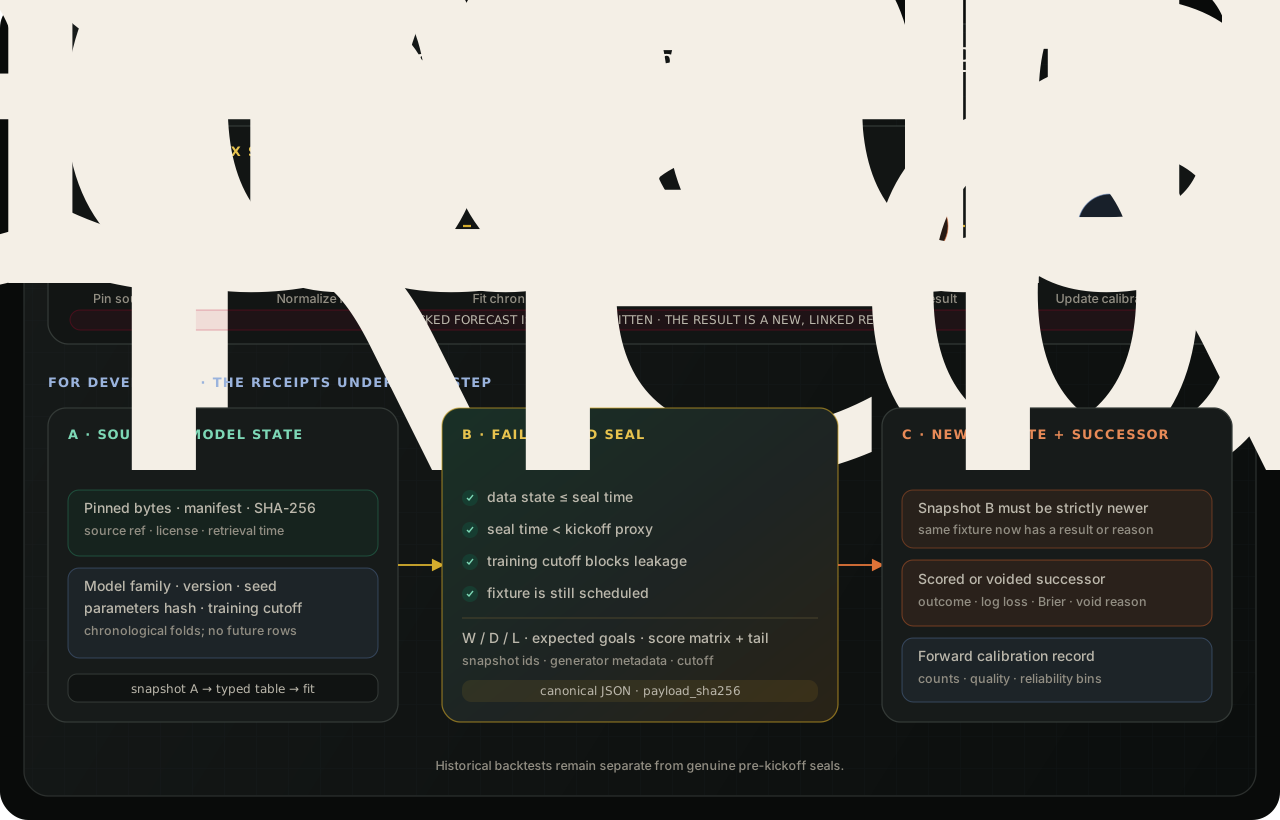
The crucial design decision is that a forecast is a claim with immutable bytes, not the current row in a mutable predictions table.
1. Retain the source state
Section titled “1. Retain the source state”Sourcepack construction writes a new pinned pack instead of overwriting the
previous one. Each pack carries its source, upstream reference, license,
retrieval time, manifest, and SHA-256 coverage. packs/snapshots.json registers
retained international snapshots so CI can replay the same scheduled→completed
transition.
2. Normalize once, model deterministically
Section titled “2. Normalize once, model deterministically”Ingest turns source-specific rows into a typed match table. Team-name history is resolved by dated intervals. Candidate families run over chronological folds: climatological, Elo ordinal-logit, independent Poisson, time-decayed Dixon–Coles, and bivariate Poisson. Model family, version, seed, parameters hash, and training cutoff are part of the eventual seal.
3. Fail the seal if time can leak
Section titled “3. Fail the seal if time can leak”seal_forecast refuses to write unless all of these hold:
- the snapshot data-state anchor is not later than the seal time;
- the seal time is earlier than the fixture’s kickoff proxy;
- every training row is at or before the recorded cutoff; and
- the target fixture is still scheduled in the sealing snapshot.
The international source publishes dates, not kickoff times. Where a pinned CC0
overlay supplies a verified kickoff, Golavo uses it and marks the row exact;
otherwise it falls back to 00:00 UTC on match day as a conservative proxy and
marks the row day. It never invents a precise kickoff time, and it never treats
a proxy as if it were one. In the committed 100,525-row index snapshot, 1,846 rows
carry a verified exact kickoff; generated metadata remains the authority as the index
changes.
That distinction is load-bearing. A date is not a time, so ordering by date alone treats every fixture on a day as simultaneous — which is exactly how a result from 20:00 could reach a forecast for a match that kicked off at 00:30 that morning. Training rows are ordered by the sharpest instant each row can prove, and where a proxy row shares a fixture’s calendar day, the surfaces that rely on it disclose that its order within the day cannot be shown.
4. Seal the complete numeric claim
Section titled “4. Seal the complete numeric claim”The ForecastArtifact records W/D/L probabilities, expected goals, and — for
goal-based candidate families — the exact-score grid plus its out-of-grid tail.
Coherence checks prove the stored matrix marginalizes back to the same W/D/L
probabilities and expected goals. The artifact also carries snapshot ids,
generator metadata, deterministic parameters, and a digest over canonical JSON.
5. Resolve with a new artifact
Section titled “5. Resolve with a new artifact”Scoring accepts a result only from a validated source state strictly newer than the seal’s. It writes a separate successor with the outcome, assigned probability, log loss, and Brier score. Postponed or abandoned fixtures produce a separate voided successor with a reason. One root seal resolves once; the original file is never rewritten.
6. Keep forward evidence separate
Section titled “6. Keep forward evidence separate”GET /api/v1/calibration recomputes counts, running quality, reliability bins,
and chain summaries from real seals. Historical evaluation folds live behind a
different endpoint and view. This prevents polished backtest results from being
presented as accumulated pre-kickoff evidence.
What proves what
Section titled “What proves what”| Evidence | What it proves | What it cannot prove alone |
|---|---|---|
| pack manifest + hashes | exact source bytes used | when Golavo published a forecast |
| model/version/seed/params/cutoff | reproducible computation state | that the source state was available publicly at that moment |
| canonical artifact digest | the seal’s payload has not changed | wall-clock creation time |
| public git history before kickoff proxy | the genuine forward seal was published in time | that a model is accurate |
| scored successors + calibration | what happened after real seals | performance outside the observed sample |
Local Intelligence and optional AI
Section titled “Local Intelligence and optional AI”The upper row answers the ordinary question — who decides what the forecast says? The lower contract shows exactly how code prevents explanation layers from becoming a second model.
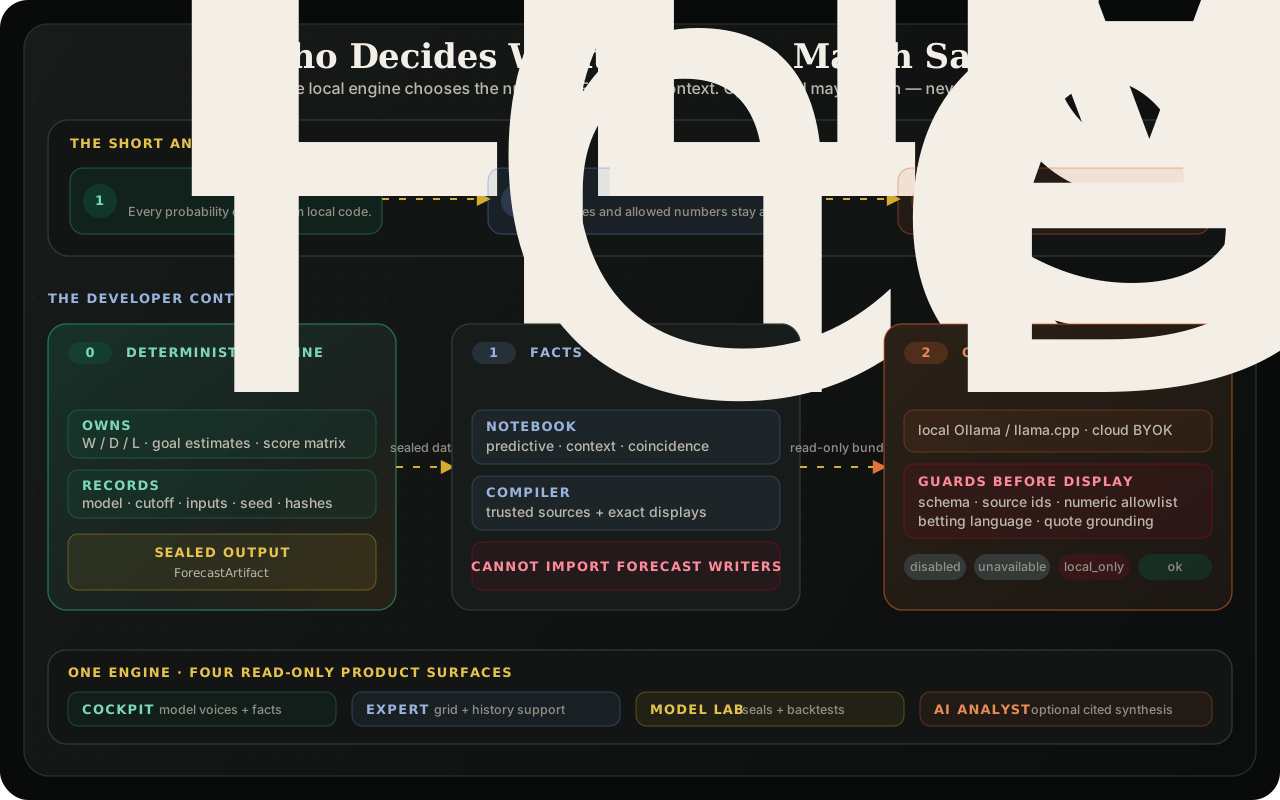
Golavo has three intelligence layers, but only one numeric authority.
Layer 0 — deterministic engine
Section titled “Layer 0 — deterministic engine”Always on and fully local. It produces the complete forecast, score matrix, sealed metadata, evaluation, and forward calibration. Turning every AI setting off changes none of those bytes.
Layer 1 — facts and evidence
Section titled “Layer 1 — facts and evidence”The Commentator’s Notebook runs pre-registered templates over source history. Every accepted fact records its label (predictive, context, or coincidence), sample, denominator, base rate where applicable, date range, freshness, and source ids. Coincidences are capped and quarantined from AI.
The facts package has a machine-checked dependency invariant: it cannot import
modules that write a forecast, probability, or calibration value. An evidence
compiler then combines the seal and safe facts into a deterministic bundle with
an allowed_numbers list. Each allowed number has an id, trusted display string,
unit, label, and source relationship.
Layer 2 — optional narration
Section titled “Layer 2 — optional narration”AI receives only the evidence bundle plus separately fenced optional context. It has no forecast write path. Before text reaches the UI, Golavo checks:
- output is valid narration-schema JSON;
- every claim cites allowed source ids;
- every numeric token exactly matches an allowed display and references the correct number id and source;
- unsupported odds/betting language is absent; and
- candidate-fact numbers are grounded verbatim in their cited quote when that separately gated mode is enabled.
The gateway returns one of four explicit states: disabled, unavailable,
local_only, or ok. A malformed, injected, unsupported, or unreachable model
response becomes local_only; the app continues with the unchanged forecast.
Presentation is not a second model
Section titled “Presentation is not a second model”Casual and Expert modes are two reads of the same artifact. Casual mode uses plain language; Expert mode exposes the seal, provenance, score matrix, and training-history support. The Model Lab’s Track record presents the real forward record. AI Deep Read optionally adds cited narrative. None of these surfaces recomputes or overrides the seal.
Source mode vs packaged mode
Section titled “Source mode vs packaged mode”| Concern | Source mode | Packaged desktop |
|---|---|---|
| UI | Vite dev server | bundled webview assets |
| API | developer-started Uvicorn | PyInstaller sidecar supervised by Tauri |
| Address | configured local base | ephemeral 127.0.0.1 port injected at launch |
| Token | unset; local development CORS only | fresh 256-bit token required for /api/* |
| Data | repository packs/artifacts | bundled read-only resources + per-user ledger directory |
| AI | off unless developer selects a provider | off unless user explicitly selects local or BYOK cloud |
| Exit | processes controlled separately | shell kills sidecar; sidecar watches parent PID |
The shared contracts make these deployment modes equivalent at the app/core boundary. The workbench validates responses rather than silently adapting to contract drift.
Failure behavior
Section titled “Failure behavior”| Failure | Result |
|---|---|
sidecar cannot start or pass /health |
no window is shown; child is killed; backed-up user state may be rolled back |
| request lacks the launch token | 401; no API data is returned |
| API response violates the UI contract | visible error state; malformed data is not rendered as a forecast |
| source snapshot or manifest fails validation | ingest/seal/score operation stops |
| seal invariant fails | no artifact is written |
| newer result is missing/postponed | no fabricated score; write a reasoned void successor when appropriate |
| optional model is absent | disabled or unavailable; local forecast remains complete |
| narration fails any guard | discard response, return local_only, preserve every engine number |
| shell exits unexpectedly | parent-PID watcher terminates the sidecar |
Build and release boundary
Section titled “Build and release boundary”Packaging is downstream of the runtime architecture:
- PyInstaller freezes the FastAPI/core sidecar and its read-only resources.
- The build copies it to Tauri’s required target-triple filename.
- Tauri bundles the UI, shell, and sidecar into platform installers.
- A stable build signs every active pack manifest before it enters the frozen sidecar.
- Release jobs emit DMG / MSI / EXE artifacts, updater signatures,
SHA256SUMS.txt, and a detached signature over that aggregate checksum ledger. - OS code signing and notarization remain conditional on platform credentials.
The current public installers are OS-unsigned, so Gatekeeper or SmartScreen may warn. That platform trust boundary is separate from Golavo’s release identity: updater payloads, official pack manifests, and aggregate checksums are authenticated before use. None of those release controls can alter a sealed artifact.
Read the contracts directly
Section titled “Read the contracts directly”forecast_artifact.schema.json— the immutable forecast/resolution shape.forecast_proof.schema.json— the portable offline-verifiable artifact lineage bundle.world_cup_history.schema.json— the isolated women’s and men’s tournament-history archive.evidence_bundle.schema.json— the constrained input to optional narration.facts.schema.json— the Commentator’s Notebook contract.ai_narration.schema.json— the only narrative shape accepted back from a provider.tournament_retrospective.schema.json— the two-layer World Cup backtest, including the typed check that its story and skill layers really came from one snapshot.- Track record — the Model Lab’s forward record: timing, resolution, and verification details.
- Prediction methodology — candidate models, chronological folds, and metrics.
- Privacy & security — runtime network and key handling.
- ADR-0001 — the desktop decision record and reconsideration triggers.