

Trust Center
Trust Center groups four local integrity jobs without contacting a provider. They answer different questions and deliberately do not collapse into one “verified” badge.
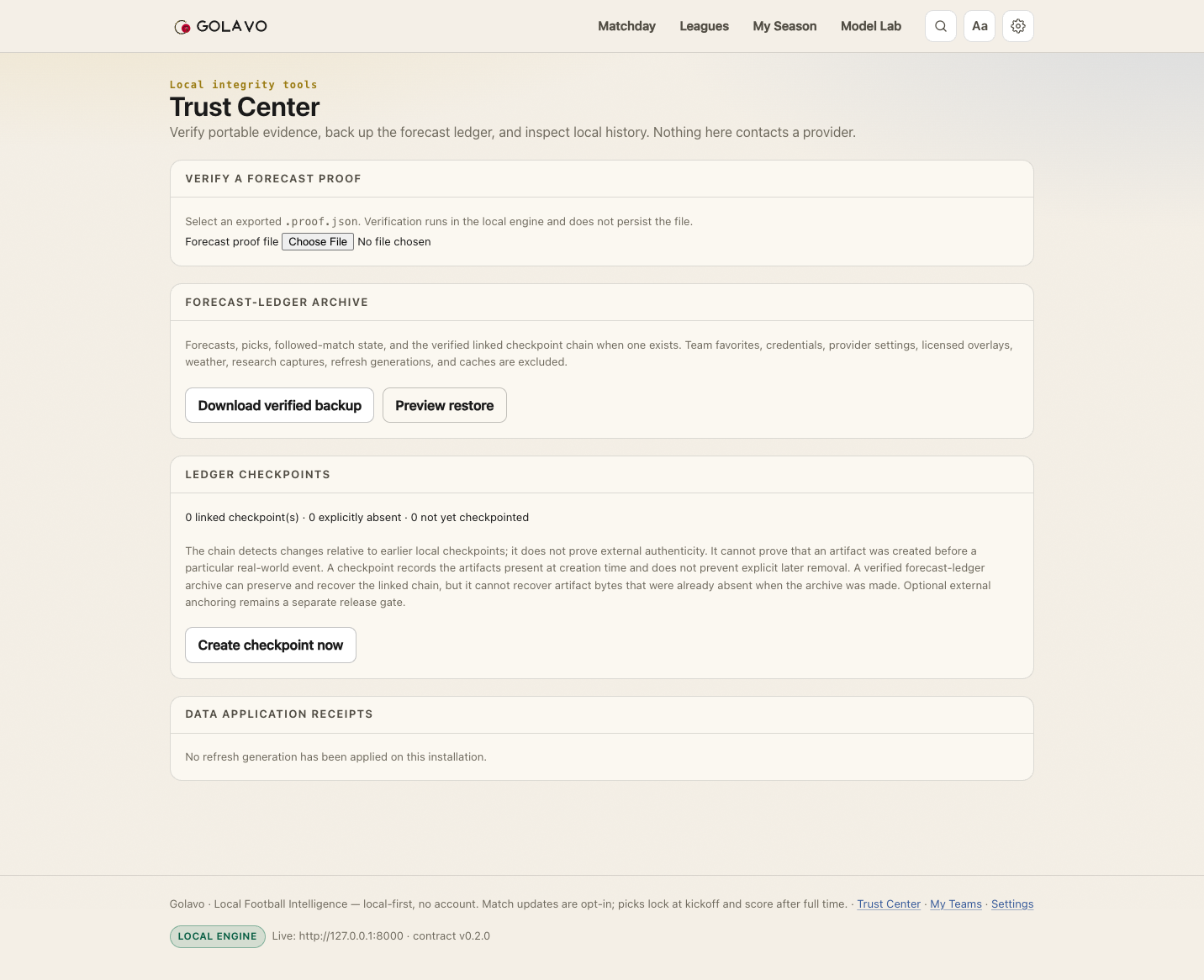
Verify a forecast proof
Section titled “Verify a forecast proof”Choose an exported .proof.json. The local engine verifies the bundle hash, each included
artifact, the connected lineage, source descriptors, and any embedded manifest hashes. It
does not persist the selected file.
The result separates embedded source manifests from descriptor-only sources. Verification does not prove external source authenticity, ledger completeness, creation time, or forecast accuracy; it proves only the bytes included in that proof.
Forecast-ledger archive
Section titled “Forecast-ledger archive”Download verified backup writes a ZIP with fixed entry metadata and a checksummed
manifest that records the export time.
Preview restore validates its paths, sizes, hashes, contracts, SQLite follow database,
and classifies every file as new, byte-identical, or different before any replacement can
occur. The classification comes from the same locked byte comparison that binds the restore
preview. A token-free JSON preview report can be downloaded for local review; it is not
authentication, timestamp evidence, or restore authorization. Archive format 0.2.0 also copies
only the verified head-reachable checkpoint records and rebuilds them with the forecast
files in a disposable ledger. Legacy 0.1.0 archives remain readable without inventing a
checkpoint chain they never contained.
| Included | Excluded |
|---|---|
| Forecast artifacts | Team favorites in browser preferences |
| Picks and pick audit | Credentials and provider settings |
| Followed-match state | Licensed overlays and provider responses |
| Verified linked checkpoint chain, when present | Weather and research captures |
| Refresh generations and derived caches |
Archives are bounded to 5,000 files and 64 MiB uncompressed. Unsafe, duplicate, symlink, or out-of-allowlist paths fail closed. Every restore must present the state-bound token from its exact locked preview; a conflicting restore additionally stays disabled until you confirm replacement of the exact listed files. The restore uses a durable recovery journal bound to the previewed local file hashes; if any covered path changes, the preview expires and a new one is required. It retains a pre-restore backup or quarantine copy so interruption does not silently leave a half-applied ledger. Restore is withheld if the rehearsed post-restore state would leave the local checkpoint chain invalid.
Ledger checkpoints
Section titled “Ledger checkpoints”A checkpoint hashes every verified fa_*.json artifact present at creation time and links
to the previous local checkpoint. Status walks the chain, detects cycles or changed bytes,
reports explicitly missing artifacts, and lists artifacts not yet in the current head.
Format 0.2.0 can append to a verified 0.1.0 head while retaining the legacy checkpoint’s
exact hashed bytes. The archive carries both formats and runs the same verifier against a
disposable recovery directory before offering restore.
The limit is important: this detects change relative to an earlier checkpoint on the same installation. It does not prove external authenticity, prove that a forecast predates a real-world event, prevent explicit deletion, or recover artifact bytes that were already absent when the archive was created. Optional external anchoring remains a future gate.
Data-application receipts
Section titled “Data-application receipts”When an approved-source refresh generation activates or rolls back, Golavo attempts to append a checksummed local receipt with the active generation, index hash, source summaries, capability certificates, and a conservative stable-identity comparison. Unresolved rows are counted separately and never guessed through an upstream rekey.
The active-pointer change and the secondary receipt append cannot be one filesystem transaction. If Golavo stops between them, the persisted refresh job records the gap and Trust Center shows it. A receipt is local application history, not an external tamper-proof audit log.
See The Prediction Ledger, Updates & rollback, and Privacy & security for the surrounding boundaries.