Offline city packs, recommendations, and maps
City packs bring local place data and prose into a trip so you can explore a destination without depending on a live service.
Recommended for this trip
Section titled “Recommended for this trip”At the top of the Offline city data panel, Voyalier matches your trip’s destination against the pack catalog and suggests the best fit — for a trip to Kyoto it offers Download Kyoto city data. The match is a local, deterministic comparison of your destination against each pack’s name, aliases, region, and Wikivoyage title (with accents and the Hawaiian ʻokina folded away, so “Kauaʻi” and “kauai” match the same pack). It runs entirely on-device: nothing about your trip is sent, and no pack is downloaded until you click.
When more than one pack could match — “Japan” fits both Kyoto and Tokyo — all of them are listed so you can choose. When nothing matches, Voyalier says so and you can still browse the full catalog below.
Browse and download
Section titled “Browse and download”The Offline city data panel lists the available packs — Nashville, the four Hawaiian islands as separate packs, and more. Each pack keeps three layers with their own licenses: Overture places and Overture amenities (both permissive) and Wikivoyage prose (share-alike), shown with per-layer attribution.
The amenities layer is the practical one — cash machines, pharmacies, public toilets, viewpoints, and hospitals — kept separate from ordinary places so you can find them on purpose. There is no drinking-water layer: no open source publishes public taps in a form that could be trusted not to point you at a decorative fountain.
Download for this trip pulls a pack’s contents from the project’s releases and stores them locally with the trip. The click is your consent, and the fetch is one-way — it pulls place data in; nothing about your trip goes out. The pack id is validated before any request, and the downloaded body is verified to match the pack you asked for. A Remove control deletes it again.
Persona-weighted recommendations
Section titled “Persona-weighted recommendations”Once a pack with places is downloaded, the Recommendations panel ranks its places by five persona weights — food, culture, nature, nightlife, and shopping — that you set with sliders (with Balanced, Foodie, and Explorer presets). Ranking is a deterministic keyword-to-dimension rule, never a model, and every pick shows its source, license, score, and the reasons it was chosen, plus one cross-dimension “wildcard.”
The weights persist with the trip. Save place keeps a recommendation’s source, license, reasons, and coordinates plus your private notes; removing the pack later leaves the saved place intact and labels the source pack unavailable. See Saved places, packing, and manual plans.
The map
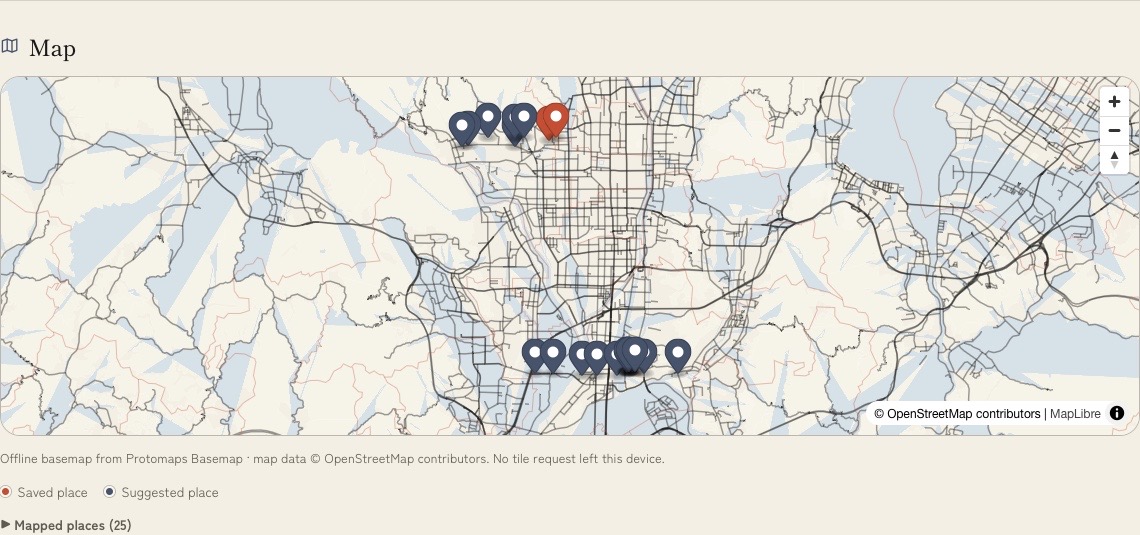
Section titled “The map”The map is consent-gated: nothing loads until you click Show map. It then fetches a keyless OpenFreeMap basemap (OpenStreetMap data) and plots your saved shortlist before the downloaded pack’s unsaved recommended places. Matching saved and recommended points appear once as saved. Those online tile requests reveal the displayed map area, which can reflect the destination and saved-place coordinates. They do not carry place names, private notes, or structured itinerary records. A downloaded offline basemap keeps even the tile reads on this device. The two states have different markers and matching text labels, and an expandable register lists every mapped place for people who do not use the canvas. The map library is a large download, so it is fetched only on that first click — if you never open a map, you never download it.
Every catalog pack can include a verified PMTiles archive. Its size varies by city and the pack panel says so before download. Once present, map tile reads stay on-device through bounded byte-range requests; if the archive is missing or fails verification, the explicit online OpenFreeMap path remains the fallback.