
Checks & lighting
Why checks exist
Section titled “Why checks exist”Reading an explanation is the weakest form of learning. Codemble makes you prove understanding with short active checks before a region lights up.
Exploring earns something too, and it is deliberately something else. Flying to a system charts it: its routes stay drawn and the star chart counts it. Only a passed check turns it amber. Being somewhere and understanding it are different claims, and the two are kept apart so that neither can be mistaken for the other.
Where questions come from
Section titled “Where questions come from”Every check is generated from your code’s real graph, so the answer is always verifiably correct:
- “Which structures does
main()call directly?” — from certain call edges - “Which files import
utils?” — from import edges - “If you deleted
foo(), what would break?” — from its callers - “Where does execution start?” — from the entrypoint
Questions and answers are deterministic in v1. The check service uses exactly four parser-owned evidence families:
- every certain direct project call from one parser-owned structure
- direct project imports
- direct callers that depend on a structure
- parser-ranked execution entrypoint
The provider is not called to phrase, score, or explain a check. The response
sent to the browser withholds the answer; submission is compared against the
immutable generated option IDs. A correct answer is confirmed with the
graph-owned answer and its real file:line evidence; a wrong one is not,
so a second attempt cannot simply replay what the screen just showed. A check
that cannot be derived with certainty is not offered.
Call checks deliberately make no execution-order claim. A source line can hold nested calls, and textual order is not Python evaluation order. When the graph proves several direct targets, all of them are required answers; the question is omitted unless the graph also supplies a real non-answer. v0.24.0 gives this contract a new deterministic check schema, so stale question IDs are refused. Saved amber understanding remains keyed to file hashes and is not silently retested or erased.
Lighting rules
Section titled “Lighting rules”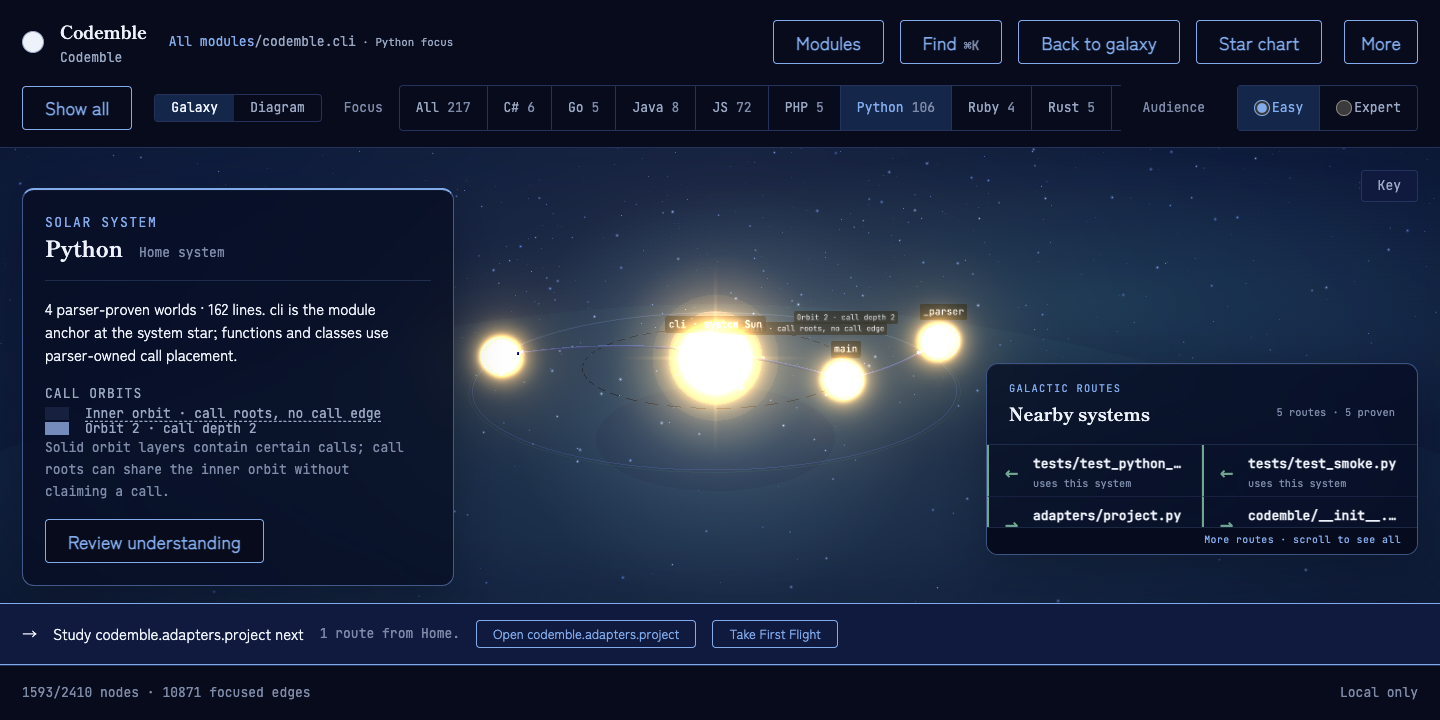
- Pass a region’s checks → its stars light permanently. Back at galaxy
level that system plays a 1.2-second nebula dawn — amber washing out
through its halo and fog and receding. The lit state is saved before the
animation runs, so the dawn marks a fact rather than delivering it, and
prefers-reduced-motionskips straight to the finished lit state. - Progress is saved locally and survives restarts.
- Edit a file → only that region re-dims. Understanding is re-earned where the code actually changed, never globally revoked.
Progress lives in a project-keyed JSON record under ~/.codemble/progress and
is written only after every offered check in the region passes. Each region is
bound to a deterministic signature of its current parser file hashes. On the
next run, matching regions light and changed regions stay dim; no background
watcher or network service is involved.
Mutations are serialized across app threads and Codemble processes before the read/modify/replace sequence begins. Project mode and the learner-wide default are two files: ordinary second-write failures restore the project value, while an outcome that cannot confirm its own rollback is reported as uncertain and requires a reload. The pair is not claimed to be crash-atomic.
Right answers say so — wrong ones send you back to the code
Section titled “Right answers say so — wrong ones send you back to the code”A correct answer is confirmed in place — “Correct. That answer is fixed by the
parser graph.” — along with the answer and the file:line evidence behind it,
before the next question loads.
A wrong answer says only “Not yet. Re-read the relationship in your own code and try again.” It withholds both the answer and the citations, because for a question like which of your files imports this one the evidence lines are the answer. You can retry as often as you like; what you cannot do is light a region with an answer Codemble just handed you.
Why a region can stay dim forever
Section titled “Why a region can stay dim forever”Every question Codemble asks is answered by the parser graph, and every question must offer at least one wrong option. A region with no certain relationship gives Codemble nothing to build a question from, so it stays dim and says so. Lighting it anyway would mean the amber said something untrue about what you understand. Import that module somewhere, or call something inside it, and its checks appear.
Starting a project over
Section titled “Starting a project over”The star chart has a Clear this project’s progress control behind a
confirmation. It forgets both halves of your record for the project you have
open — the understood regions and the systems you explored — and nothing else:
progress is stored per project in ~/.codemble/progress/, and other projects
keep theirs. Your Easy/Expert preference survives the reset.